
Introduction
Reframing the Research Question
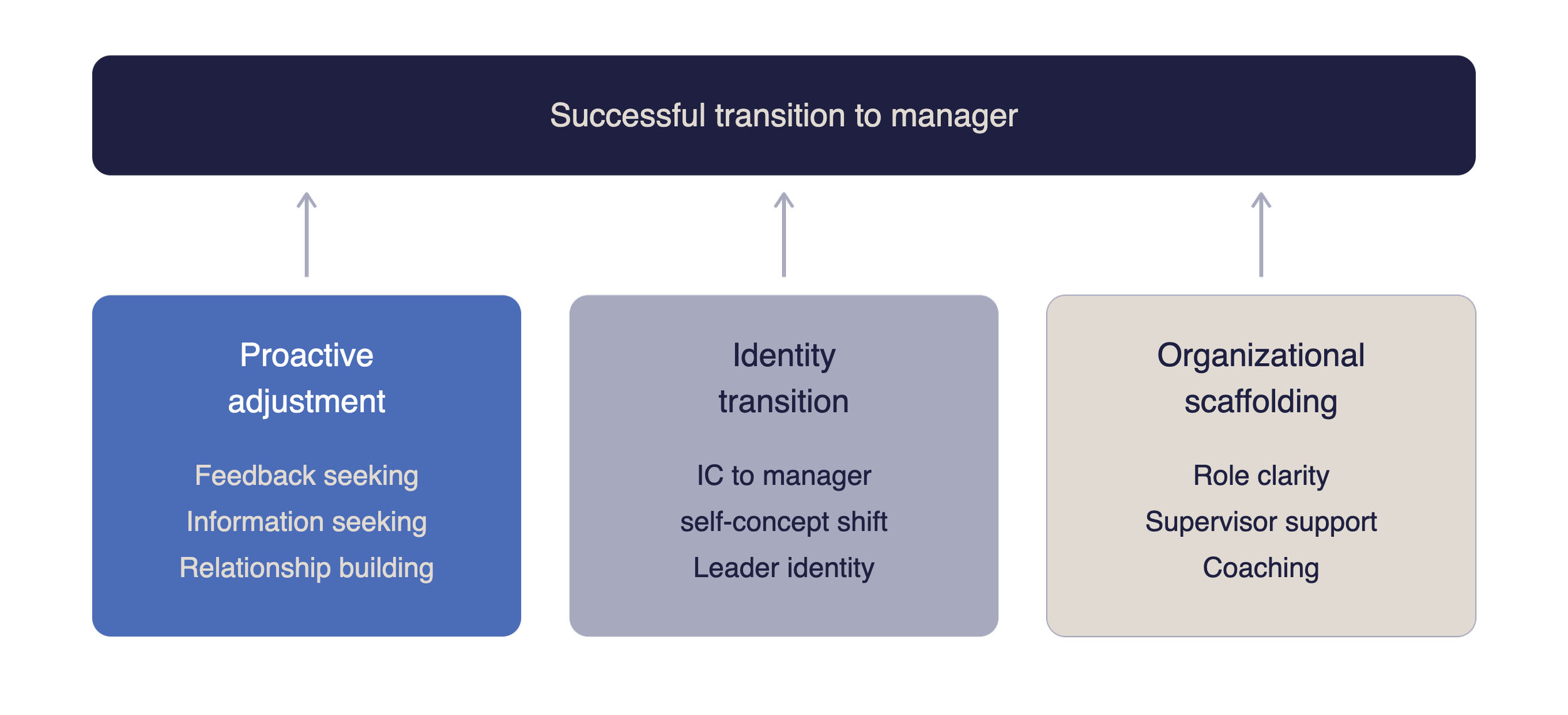
The original commissioning question asked what competencies predict successful IC-to-manager transition. Prior work concluded that this question, asked directly, does not yet have a well-supported quantitative answer in the accessible literature. This document asks a narrower, more answerable question: what does the empirical literature support about the three pillars — proactive behavior, identity transition, and organizational scaffolding (role clarity, coaching, and supervisor support together) — that emerged as the most defensible integrative account from that prior work, and how strong is the evidence for each, individually and in combination.
Why This Reframing Matters
A three-pillar process model is more useful to organizations than a static competency list, because the scaffolding pillar — role clarity, coaching, supervisor support — is directly under organizational control, meaning organizations can act on this evidence today rather than waiting on a validated selection tool that does not yet exist.
Research Context
Each pillar draws on a distinct, mature literature: proactive behavior and role clarity both sit within newcomer-socialization and role-stress research, which is quantitatively strong but was developed on general employees, not specifically promoted managers. Identity transition sits within the leader-development and leader-identity literature, which is theoretically strong but quantitatively thinner. The coaching and supervisor-support component of scaffolding draws on both the role-stress literature (leader support as a moderator) and the coaching-effectiveness literature (RCT-based, moderate effects, self-disclosed publication-bias risk).
Importance to Organizations
Actionability: the scaffolding pillar is a set of organizational design choices, not just selection criteria — meaning organizations can act on this evidence even absent a validated selection tool.
Performance and retention: role ambiguity has one of the most robust, decades-deep negative relationships with performance and satisfaction in the entire organizational behavior literature, which plausibly makes it a high-leverage target during any role transition, including promotion to management.
Culture: leader/supervisor support was shown in at least one real field study to convert role ambiguity from a harmful stressor into a more benign or even engaging challenge, suggesting the surrounding organizational culture — not just the individual manager's traits — substantially shapes transition outcomes.
Succession planning: this reframing implies succession planning should invest as much in structuring the first months of the new role as in selecting who gets promoted.

Key Findings
Finding 1 — Proactive Adjustment Behavior Predicts Role Adjustment, and Is a Direct Antecedent of Organizational Scaffolding
Narrative synthesis: proactive behavior is not just independently associated with better adjustment outcomes; the classic newcomer-adjustment literature explicitly models it as an antecedent of role clarity, meaning this pillar is causally and empirically connected to the organizational-scaffolding pillar (Finding 3) rather than merely co-occurring with it.
Supporting evidence: Bauer, Erdogan, Ellis, Truxillo, Brady, and Bodner (2025, Journal of Management) meta-analyzed 256 studies (183 pooled) and found that proactive behaviors — feedback seeking, information seeking, relationship building, job crafting — collectively explain roughly 19%–37% of variance in socialization/adjustment outcomes. Anseel, Beatty, Shen, Lievens, and Sackett (2015, Journal of Management) independently synthesized three decades of feedback-seeking research with convergent conclusions. Bauer, Bodner, Erdogan, Truxillo, and Tucker's (2007) path model explicitly places information-seeking as an antecedent of role clarity, which in turn predicts distal outcomes including job performance and retention.
Evidence quality: high; multiple large, independent, recent meta-analyses converge, and one (Bauer et al., 2007) directly models the causal link between this pillar and the scaffolding pillar rather than leaving them as separate, unconnected claims.
Mediators/moderators: culture (horizontal-individualistic vs. vertical-collectivistic) moderates some proactive-behavior effects (Bauer et al., 2025); organizational justice and supervisor feedback quality moderate the proactive-personality-to-feedback-seeking link.
Practical implication: new-manager onboarding should not just make information available passively but actively prompt and reward information- and feedback-seeking, since this behavior appears to be a direct mechanistic pathway to the role clarity that Finding 3 establishes as strongly predictive.
Finding 2 — Identity Transition Is Core to the Theoretical Model
Narrative synthesis: the most directly on-topic literature — Jiang, Zhu, and Harold's (2026) systematic review of 136 articles on leader role transition — frames the transition as simultaneously behavioral (adjustment), psychological (identity transformation), and social (validation by others), which conceptually unifies Findings 1 and 3 (behavioral adjustment and organizational scaffolding) with a psychological identity-change process.
Supporting evidence: Hill's classic longitudinal qualitative study of 19 new managers, and a 2022 Danish qualitative study of 7 first-line managers across 49 interviews, both describe an identity "unlearning" and reconstruction process as central to the first months of management. Callina et al.'s (2020) longitudinal study of 80 high-potential executives linked leader identity and self-efficacy to competency development and promotion timing. Morgan et al. (2025) found that a "future leader self" identity predicted motivational and behavioral leadership outcomes across a multi-study longitudinal design. Hammond, Thrasher, and Vogelgesang Lester's (2025) systematic review of the broader leader-identity literature found it theoretically active but methodologically fragmented, calling for more rigorous longitudinal designs.
Evidence quality: theoretically strong, quantitatively weak-to-moderate. This remains the pillar most in need of large-sample, quantitative, first-time-manager-specific testing.
Practical implication: developmental support for new managers should explicitly name and support the identity shift — letting go of individual-contributor status and habits, building legitimacy as a leader — not simply provide role clarity and coaching without addressing this underlying psychological process.
Finding 3 — Organizational Scaffolding (Role Clarity Plus Supervisory Support and Coaching) Is the Best-Evidenced Pillar
Narrative synthesis: role clarity, supervisor support, and coaching are treated here as three expressions of one pillar — organizational scaffolding — because all three are organizationally designable conditions that reduce ambiguity and provide support during the transition, rather than individual traits the new manager brings with them. Taken together, this is the strongest and most convergent evidence base in the model.
Finding 3a — Role Clarity
Supporting evidence: Jackson and Schuler's (1985) meta-analysis of 96 studies found role ambiguity negatively associated with job satisfaction, organizational commitment, and performance. Tubre and Collins (2000) re-analyzed and extended this work, reporting a moderate negative role ambiguity–performance relationship (ρ ≈ -.21), moderated by job type and performance-rating source. Bauer et al.'s (2007) meta-analysis, built on 70 newcomer samples, found that role clarity mediates the effects of socialization tactics and information-seeking on job performance, satisfaction, commitment, and retention. A more recent, large-scale role-stressor meta-analysis was also located, reportedly synthesizing several hundred studies and hundreds of thousands of workers and identifying role ambiguity as the most damaging of the classic role stressors.
Finding 3b — Supervisory Support and Coaching
Supporting evidence: Martínez-Díaz, Mañas-Rodríguez, Díaz-Fúnez, and Aguilar-Parra (2021), in a field study of 315 public employees, found that supervisor/leader support moderates the negative effect of role ambiguity, converting it into a less harmful or even a positive challenge-demand for engagement and extra-role performance. Separately, a 37-RCT meta-analysis restricted to randomized controlled trials (n = 2,528), published in Academy of Management Learning & Education, found a moderate overall coaching effect (g ≈ .59) on leadership and personal outcomes, and Jones, Woods, and Guillaume (2016) independently reported convergent moderate-to-large coaching effects on learning and performance outcomes.
Practical implication (Finding 3 overall): pairing role clarity with active supervisory support and/or coaching is better evidenced than relying on either alone, and directly buffers the specific harm — ambiguity-driven strain — that this literature identifies as most damaging during role transitions.
Finding 4 — The Three-Pillar Interaction Is a Well-Grounded Hypothesis, Not a Tested Finding
Narrative synthesis: no single source retrieved in this synthesis, or the prior one, tests proactive behavior, identity transition, and organizational scaffolding together, in a first-time-manager sample, against an objective transition-success outcome. Each pillar's individual evidence is real and, for Findings 1 and 3 in particular, unusually strong and convergent.
Practical implication: organizations can act on each pillar independently with reasonable confidence — proactive-behavior norms, organizational scaffolding (role clarity and coaching), and identity-aware onboarding — without the inherent need to build a rigid program using all three pillars. This flexibility is warranted as each pillar was tested independently in existing research literature and there has been no finding thus far that these three pillars need to work together in a particular sequence in order to produce positive results.
Practical Implications
Recommendation 1: Build active feedback- and information-seeking into new-manager onboarding
Recommendation: structure regular prompts for new managers to seek feedback and information from their manager, peers, and direct reports, framing this explicitly as the mechanism by which role clarity is achieved, not as a sign of inadequate preparation.Conditions for effectiveness: works best where organizational justice and supervisor feedback quality are both reasonably high.Implementation considerations: pair with psychological-safety training for the new manager's own manager.
Potential risks: over-frequent feedback-seeking without visible action can itself signal low confidence to subordinates.
Recommendation 2: Name and support the identity transition explicitly
Recommendation: explicitly address the individual-contributor-to-manager identity shift in onboarding conversations and create peer cohorts of other first-time managers for social validation, rather than treating the transition as purely a skills- and structure-transfer problem.Conditions for effectiveness: most relevant in the first two to six months, per the qualitative timeline evidence.Implementation considerations: requires the new manager's own manager to actually stop evaluating them on individual-contributor metrics.
Potential risks: without this correction, organizations often continue rewarding former IC behaviors even after promotion, undermining the other pillars.
Recommendation 3: Build organizational scaffolding — engineer role clarity and provide supervisory support or coaching
Recommendation: explicitly define decision rights, success criteria, and authority boundaries for new managers rather than assuming these are self-evident from the new title, and pair every new manager with either an actively engaged direct supervisor or a formal coach for a defined period, since supervisory support has direct evidence of buffering the specific harm — role ambiguity — this model identifies as most damaging.Conditions for effectiveness: clarity effects are moderated by job type and rating source, so tailor to role complexity rather than templating; coaching effects are larger for self-reported than independently observed outcomes, so pair with objective performance tracking.
Implementation considerations: budget for sustained engagement (months, not a single onboarding session) and involve the new manager's own manager directly, since role clarity is partly a function of what that manager communicates.
Potential risks: over-specifying roles in genuinely ambiguous, fast-changing environments can reduce adaptive performance; published coaching effect sizes likely overstate real-world effects due to disclosed publication bias, so set realistic expectations.
Source:
Alihodzic, S. and Pruitt, C. (2026). An Evidence-Grounded Model of Successful IC-to-Manager Transition: Proactive Adjustment, Role Clarity, and Identity Transition