
Time Off as a Strategic Lever: What 15 Years of Research Says About PTO and Employee Engagement
Employee engagement is often discussed as a culture issue—purpose, leadership, recognition, and growth. But a growing body of evidence suggests a more basic lever is hiding in plain sight: time away from work.
A meta-analysis by the Center for Applied Leadership and Decision Science spanning 2010–2025 synthesized 15 peer-reviewed studies to examine how company-sponsored time away—paid vacation, flexible leave policies, and time-off incentives—relates to engagement. The takeaway is clear: access to time off is consistently associated with higher engagement, but the real gains come from whether people use it and whether the organization makes it psychologically safe to disconnect.
Across the studies, the relationship between access to time off and employee engagement explains roughly 4%–9% of the variance in engagement—meaning it is not the only driver, but it is a reliable contributor. If time off functions as a replenishing resource, then PTO policy design becomes more than a benefit decision—it becomes a workforce performance decision.
Availability isn’t enough: vacation use drives the engagement gains
One of the most consistent findings in the research is that utilization of time off matters more than the availability of time off on paper. Employees who regularly take vacation report meaningfully higher engagement. In some datasets, employees who took at least one extended vacation annually reported 12%–25% higher engagement scores than those who took minimal leave. This is the first major “implementation gap” many organizations face: they offer time off, but workloads, norms, and implicit expectations prevent people from taking it.

Why time off works: recovery reduces burnout, which unlocks engagement
The research points to a central mechanism: time away supports recovery, which reduces burnout—especially emotional exhaustion—and that reduction enables engagement to rise. When employees take time off and actually recover, studies show reductions in burnout (β ≈ −.20 to −.35). Mediation analyses suggest that roughly 40%–60% of the PTO → engagement relationship is explained by reduced exhaustion.
This is an important reframing for corporate leaders: time off doesn’t “motivate” people in the simplistic sense. It removes a constraint. It restores capacity—cognitive, emotional, and physiological—so people can bring energy and focus back to work.
The quality of time off matters more than the quantity
The review highlights diminishing returns beyond moderate vacation durations. Longer isn’t automatically better. What matters most is whether time away produces psychological detachment—the ability to mentally disengage from work. Employees who keep checking email, monitoring Slack, or mentally rehearsing tasks during PTO experience weaker or even negligible recovery benefits, even if the number of days off is the same. In contrast, recovery experiences (including detachment) predict post-vacation engagement and creativity with meaningful effect sizes (β ≈ .25–.35). The implication is straightforward: if your organization wants engagement benefits from PTO, it must make disconnecting possible.
Time-off incentives can outperform cash in building commitment
Several studies in the synthesis suggest that time-off rewards can increase employees’ psychological connection to the organization more effectively than financial bonuses. Experimental evidence indicates that employees receiving additional leave reported stronger feelings of being valued and “humanized” at work. These effects appear to operate through perceived organizational support (POS)—the belief that the organization cares about employees’ well-being. That matters because POS has a strong relationship with engagement in broader meta-analytic research (often in the range of r ≈ .40–.50). In other words, time-off rewards may not just provide recovery; they can also send a powerful cultural signal.
Culture is the multiplier (or the killer)
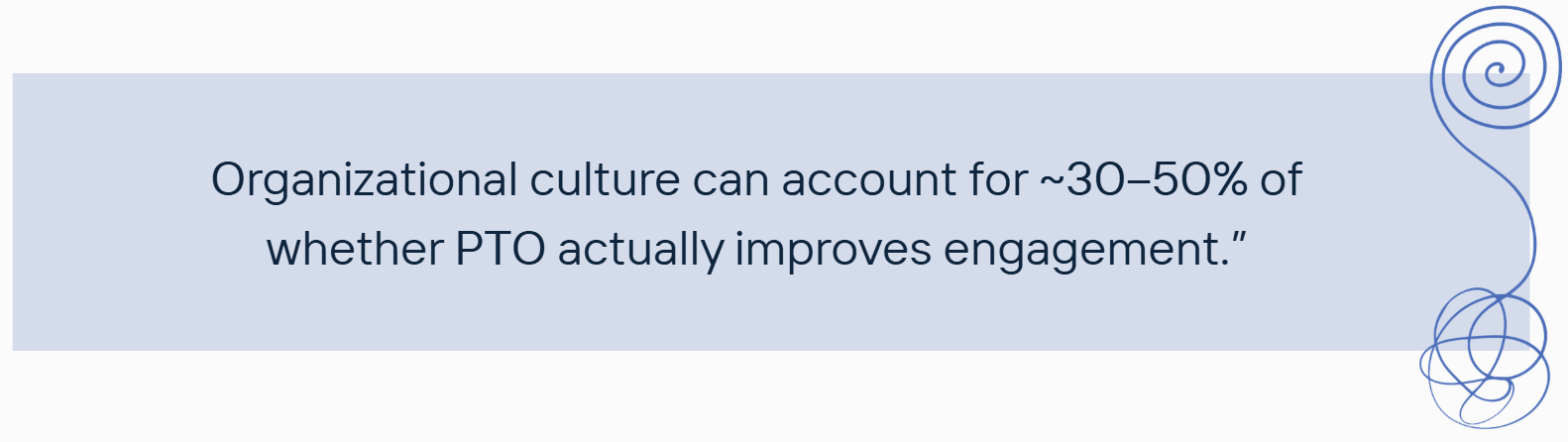
Perhaps the most actionable conclusion in the review is that organizational culture determines whether time-off policies work. Even generous PTO can fail if employees perceive “leave stigma”—the belief that taking time off will harm their reputation, burden colleagues, or signal low commitment. Studies show leave stigma is associated with reduced PTO utilization and is also directly linked to lower engagement. The review suggests culture can moderate the PTO–engagement relationship substantially (on the order of 30%–50%). That means the same policy can produce very different outcomes depending on leadership behavior, workload norms, and how absence is handled.
Leaders are the primary signal. If senior leaders take PTO but remain constantly available, they inadvertently teach the organization that “time off” is performative. If managers delay approvals, reward responsiveness, or fail to plan coverage, they create a system where PTO exists but is not usable.
What this means for Human Resources, Managers, and Leaders
If you want time off to translate into engagement, treat it like a capability—not a perk. The research suggests three broad actions.
1) Make PTO utilization a norm, not an exception: Encourage people to take PTO proactively (not just approve requests). Build predictable coverage plans so time off doesn’t create downstream chaos. Use reminders and planning cycles to reduce “I’ll take it later” behavior.
2) Design for real recovery and detachment: Establish clear expectations about after-hours and during-PTO communication. Create handoff practices so work can move without the person. Encourage at least one extended break annually, since evidence suggests strong benefits when employees take an extended vacation.
3) Use time off as a strategic signal: Consider time-off incentives as part of recognition and rewards. Ensure criteria are transparent and equitable. Pair policy changes with manager enablement so the culture aligns with the intent.
Time-off rewards can reinforce a message that performance and sustainability are linked—and that the organization values people as humans, not just output.
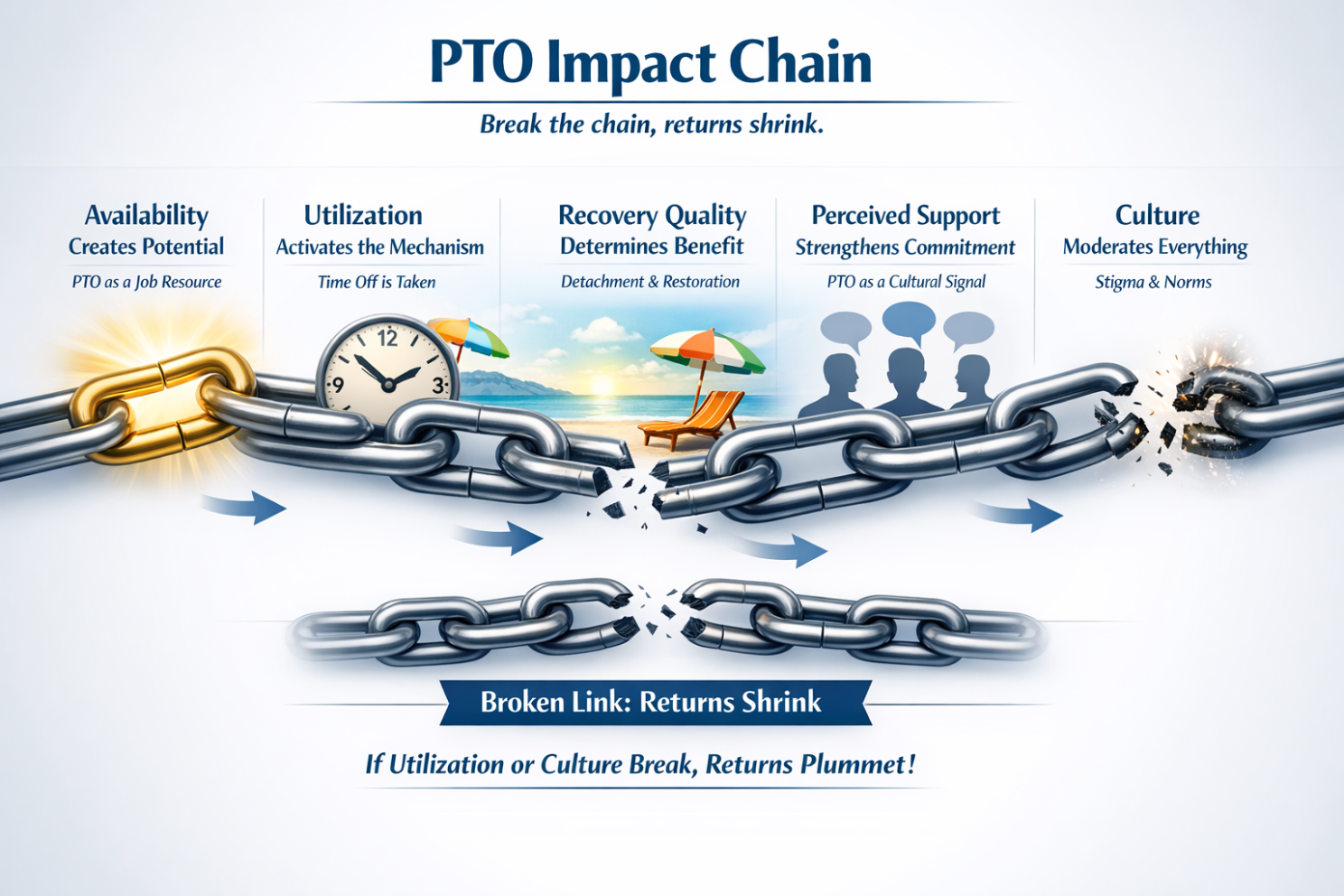
A practical synthesis: the “PTO impact chain”
The research points to a multi-stage system. If any link breaks—especially utilization or culture—returns shrink dramatically.
Bottom line
Company-sponsored time away from work is not a soft benefit. The evidence indicates it is a measurable lever for engagement, operating through recovery, burnout reduction, and perceived organizational support. But the policy itself is only the starting point. The organizations that see the biggest gains are those that normalize PTO use, protect real detachment, and build a culture where time off is psychologically safe. For corporate professionals, managers, and HR leaders, the opportunity is to move from “we offer PTO” to “we operationalize recovery.” That shift is where engagement benefits become real.
Source:
Alihodzic, S. and Pruitt, C. (2026). Impact of Company-Sponsored Time Away from Work on Employee Engagement: A Systematic Review and Meta-Analysis (2010–2025).